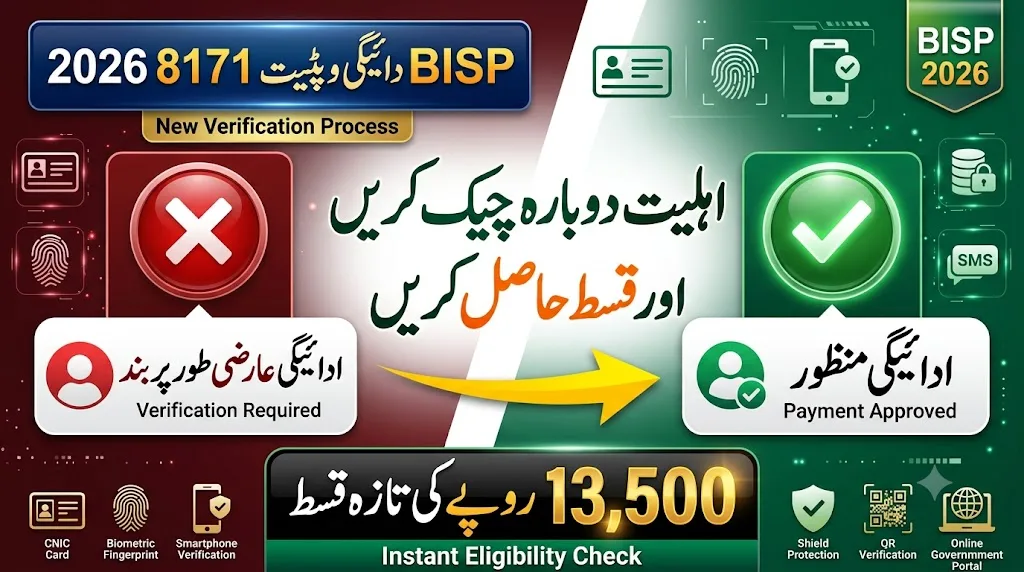
BISP 8171 Registration: Eligibility, and Payment Check 2026
Millions of Pakistani families depend on government financial support to meet basic daily needs. If your household is among them, knowing how to use the BISP 8171 system correctly can make a real difference. Whether you’re checking your eligibility for the first time, tracking a quarterly payment, or trying to understand why your status changed, this guide covers everything in plain, simple language. The BISP 8171 portal and SMS service are the most direct ways to access Benazir Income Support Programme information, and in 2026, both tools are more capable than ever. Download NTS Roll No Slip.
What Is BISP 8171?
BISP 8171 refers to both the official short code and web portal for Pakistan’s Benazir Income Support Programme. The programme itself has been running since 2008 and remains the country’s largest social protection initiative. As of 2026, more than nine million households are registered under BISP, receiving quarterly cash transfers that help cover essential expenses like food, healthcare, and children’s education.
The number 8171 serves two functions. First, it’s the SMS short code you send your CNIC to for an instant eligibility check. Second, it’s the gateway to the web portal where you can view registration status, payment history, survey records, and your household’s current PMT score standing. Both channels connect directly to the National Socio-Economic Registry database, pulling live data rather than outdated lists.
BISP 8171 Registration Check: Who Qualifies?
Eligibility for BISP support isn’t decided arbitrarily. The system uses a Proxy Means Test score to calculate each household’s level of financial vulnerability. That score is generated from data collected during the NSER Dynamic Survey, including household income, assets, number of family members, housing conditions, and education levels of household members.
Households with a PMT score of 32 or below are generally considered eligible for BISP Kafalat cash transfers. Those above that threshold are treated as relatively more financially stable, even if daily life still feels difficult. The score captures many factors beyond just income, which sometimes surprises families whose monthly earnings are low but who own assets like land or a motorcycle that push the score above the qualifying threshold.
Women-headed households, families with disabled members, and households with very young children tend to receive priority consideration in the eligibility system.
How to Check Status by CNIC
There are two methods available, and both are completely free.
The SMS method is the simplest. Open your phone’s messaging app, type your full 13-digit CNIC without dashes or spaces, and send it to 8171. A reply arrives within minutes showing your eligibility status. This works on all Pakistani mobile networks and requires no smartphone or internet connection.
The web portal method provides more detail. Enter your CNIC on the official 8171 portal homepage, complete the captcha verification, and submit. Results appear almost instantly. The portal shows your current eligibility status, survey registration details, payment history, and any flags on your household record.
For anyone using the portal during peak traffic periods, early morning access is usually faster. Traffic spikes significantly right after payment cycle announcements.
| Status | What It Means |
|---|---|
| Eligible | Household qualifies based on current PMT score |
| Not Eligible | Household income or assets exceed the support threshold |
| Payment Issued | Quarterly disbursement has been released to your payment channel |
| Under Verification | Data is being cross-checked against NSER records |
| Survey Not Found | No NSER Dynamic Survey record exists for your household |
| CNIC Not Found | The number entered doesn’t match any record in the system |
The “Under Verification” status is frequently misread as a rejection. It isn’t. It means your file is actively being processed in the queue. Give it time before checking again, and avoid submitting repeated requests which don’t speed up the review.
BISP 8171 Dynamic Survey and New Registration
If your household has never been captured in the NSER system, the BISP 8171 portal will return no data when you check your CNIC. That’s not a rejection. It simply means there’s no survey record on file yet.
To fix this, visit your nearest BISP Tehsil office and register for the NSER Dynamic Survey. A data collection team will visit your household or you may be able to submit information directly depending on your district. Once your survey data is uploaded and verified, the 8171 portal will begin showing your household record.
Here are the key steps once you have a record in the system:
- Send your CNIC via SMS to 8171 or log in to the web portal
- Confirm your eligibility status is showing correctly
- Check your payment status before visiting a payment outlet
- If status shows any issue, visit your nearest BISP Tehsil office with original CNIC
- For outdated survey data, request a re-survey to update your PMT score
BISP Kafalat Payments
BISP Kafalat is the cash transfer component specifically directed at women registered as heads of household. Payments are issued quarterly, which means four times per year. The current quarterly amount is Rs13,500 per eligible household.
Payments are collected through designated bank branches, payment agents, and in some areas digital wallet channels. Biometric verification using the registered woman’s fingerprint is required at the point of collection. If biometric data hasn’t been verified yet, that needs to be completed before the first payment can be released.
The BISP 8171 portal shows whether your current quarter’s payment has been issued, which payment outlet it’s been sent to, and the exact date the transfer was made. Checking this before visiting a payment center saves unnecessary travel.
Frequently Asked Questions
Q: Is checking BISP 8171 status through SMS or the portal free?
Completely free on both channels. The SMS to 8171 costs nothing beyond the standard network message charge your carrier applies, and the web portal carries no fees whatsoever. Nobody should ever charge you to check your BISP status. If someone is asking for payment to run an eligibility check for you, that is a scam.
Q: My status says Not Eligible but my family is genuinely struggling. What can I do?
Your eligibility is tied to your PMT score from the NSER survey. If your financial situation has genuinely worsened since that survey was conducted, you have the right to request a re-survey at your nearest BISP Tehsil office. A new survey with current, accurate data may produce a different PMT score that shifts your eligibility outcome. It’s worth pursuing if your circumstances have changed significantly.
Q: How often are BISP Kafalat payments released?
Payments follow a quarterly cycle, meaning four times per year. Exact release dates vary slightly by cycle and regional rollout schedules. The 8171 portal and SMS service both reflect payment status in real time once a disbursement has been processed for your household. Checking before you travel to a payment outlet is always the smart move.
Q: Can I use the 8171 portal on a basic phone without internet?
Yes. The SMS method is specifically designed for basic phones and areas with no internet access. Send your 13-digit CNIC without dashes to 8171 from any Pakistani mobile network. You’ll receive a status reply within a few minutes. It doesn’t provide the full detail the web portal does, but it gives you the core eligibility and payment confirmation you need.
Q: What should I do if my CNIC is expired and the system won’t recognize it?
An expired CNIC causes the system to return a CNIC Not Found result. Renew your identity card at the nearest NADRA office before attempting to check again. The BISP system cross-references NADRA’s live database, so only a currently valid CNIC will return an accurate result.
Q: Does the E Learn She Earn Program have anything to do with BISP?
They’re separate government programmes. BISP provides direct cash support to low-income households. The E Learn She Earn Program online apply for women in Punjab is a skills and employment initiative run through PITB and PSDF for women across Punjab who want to build digital careers. They serve different purposes, but both are legitimate government programmes that deserve attention from eligible women in 2026.
BISP 8171 Registration
برائے مہربانی اپنی معلومات درست اور مکمل فراہم کریں۔